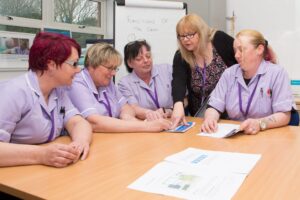
Supportive is a County Durham not-for-profit that has delivered people-centred social care since 1994, when it was known as the Social Resource Centre. Its two main services are domiciliary care and volunteer driver transport, both delivered on a charitable basis with a commitment to first-class service for customers and the best possible conditions for staff.
As the organisation grew, its back-office processes did not grow with it. Supportive needed technology that could support new contracts, standardise complaint handling, and work reliably for staff spread across a large and often rural county.
Management recognised that the business lacked the processes and technology to support expansion. The core system had been implemented some years earlier, and each time the team explored a new initiative there was a corresponding need to develop into new areas and support the people involved with appropriate technology. Formalising back-office processes — message handling and complaint handling among them — was identified as the route to the efficiency the organisation needed. Without it, every new service line would have added proportionally more administrative load, and staff time would have gone into paperwork rather than into care.
Complaints were the clearest gap. There was no system in place to handle them, so issues were dealt with differently every time depending on who received them and how. For a care provider, that is a real exposure: complaints in adult social care can be escalated externally, and providers are expected to show what was raised, when it was acknowledged, what was investigated and how it was resolved. Handling each case on its own merits makes that evidence difficult to produce and makes patterns across cases almost impossible to spot.
At the same time, Supportive secured a contract to provide outsourced services to Durham Dales Health Federation (DDHF) and recognised that a paper-based process could not satisfactorily maintain it. Employees would be working across a broad and sometimes remote geographic area, which ruled out anything that assumed a desk and a stable connection. Records were scattered between field notes, head office calls and returned paperwork, yet the resulting information still had to be shared onward with a variety of health organisations and local doctors’ surgeries, each with its own requirements.
Builda created a no-code domiciliary care software system to support the DDHF contract, built around how the work actually happens rather than around where a computer happens to be. The same domiciliary care software system is usable in the head office, from mobile devices, and from standalone apps in remote areas where connectivity is unreliable. Staff capture information once, at the point of delivery, in the form the contract requires. Because the platform is no-code, the domiciliary care software system was configured to Supportive’s process rather than Supportive adapting its process to fit the software — and it can be adjusted again as the contract evolves.
All captured information is aggregated within a central system, where it is processed and manipulated to output data to the health organisations and doctors’ surgeries that need it. One dataset serves several audiences, with no manual re-keying and a single place to look when a figure needs checking. Supportive also implemented an electronic message-handling process for internal staff, so all calls for employees are recorded and escalated within a digital platform rather than passed on as handwritten notes or verbal handovers. Each message has an owner, a timestamp and a status, so it either gets actioned or it becomes visible that it has not.
For complaints, the management team insisted on complying with the high standards set out in the published model processes for the sector. Complaints arrive through multiple channels — phone, email, in person, via a family member or a commissioner — and are recorded electronically and categorised so they enter the same process however they come in. Each one is acknowledged with a unique reference for the customer, and the workflow provides step-by-step guidance for staff. Where investigation is needed, the system helps distinguish genuine service failings from unreasonable or misinformed expectations, and from weaknesses elsewhere in the supply chain that fall outside Supportive’s responsibilities.
The DDHF contract transitioned without disruption. Employees received training in the business requirement from DDHF and in the domiciliary care software from Builda, so they understood both what the contract asked of them and how the system supported it. Supportive’s own people became the enablers of the transition, and both parties came out of the project with the benefits of a successful implementation and no adverse impacts. Field teams can now record information at the point of delivery anywhere in the county, connection or not, which means records are made while the detail is fresh rather than hours later from memory.
The domiciliary care software system now consists of a complaint handling is consistent for the first time. A complaint follows the same documented route regardless of which channel it arrives through, who receives it or how busy the team is that week, and it can be tracked through to resolution. Supportive can produce a full history of any case on request — the reference issued, what was investigated, what the outcome was — which is exactly the evidence commissioners, regulators and ombudsman services ask for. Management can also look across cases and see whether the same issue keeps recurring.
Internally, communication no longer depends on someone remembering to pass a message on, and reporting no longer depends on assembling figures by hand from records held in different places. Outputs for health organisations and GP surgeries are generated from one central dataset, which removes a recurring administrative task and reduces the risk of transcription errors reaching external partners. Rather than commissioning a bespoke build, Supportive worked from its own design brief and had a working system in place quickly and cost-effectively — freeing back-office capacity to support expansion into new service areas.
“Supportive has been using Builda’s no-code domiciliary care software system to support the management of information within our care service. We have found the no-code domiciliary care software system to be simple to use with excellent support from their team. Builda used our design brief to deliver a fast and cost-effective quality solution without the need to spend a protracted period developing a bespoke system. We are currently introducing a new complaints system which meets government standards, provides step-by-step guidance for staff using the system and will enable full tracking of complaints or concerns which need to be addressed.” John Davison, CEO, Supportive